
A Waitangi Day reflection through the eyes of my ancestors
Suitauloa Simon Young
This post was originally a live video on the One Ancestor at a Time YouTube channel. Subscribe for weekly live video updates
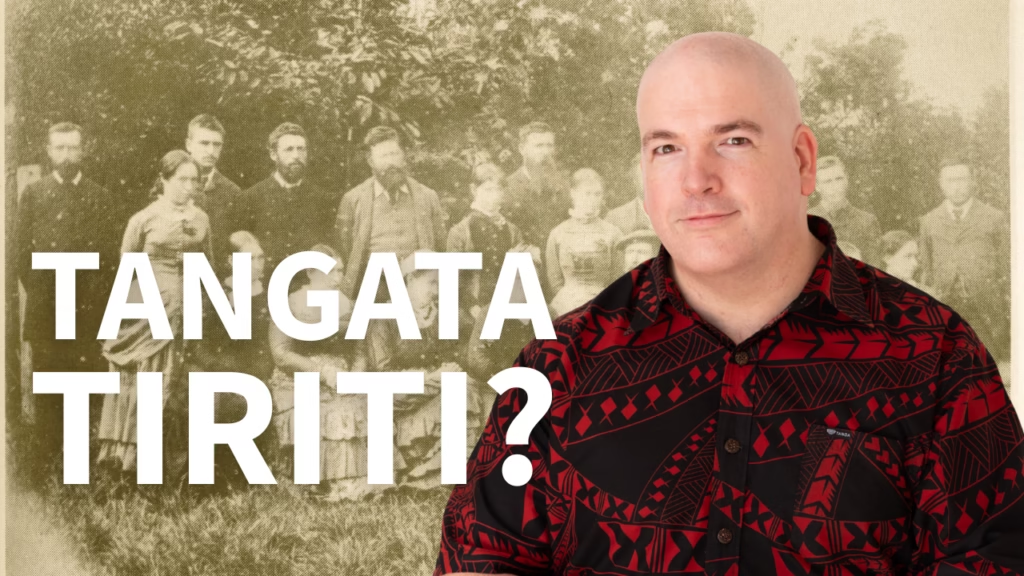
Waitangi Day is often described as our national day. There are concerts, flags, barbecues, and a general sense that this is a day to celebrate who we are as a country. But for many people, Waitangi Day is not a celebration. It is a commemoration.
This year, as music drifted over from a local park and crowds gathered elsewhere, I found myself at home, reflecting. Reflection feels like the right posture for this day. Because what is being remembered is not simple, and it is not settled.
This reflection is personal. It comes from my own experience, my own education, and my own ancestry. I’m not speaking for anyone else. But because this is One Ancestor at a Time, I want to explore what Waitangi Day means when you look at it through the lives of the people who came before you—and what that asks of us now.
My ancestors were arriving as the Treaty was being signed
On 6 February 1840, the Treaty of Waitangi was signed in the far north of Aotearoa. At roughly the same time, my ancestors were in the very early stages of building a life at the other end of the North Island.
Thomas Urquhart Mackenzie was a young Scottish gardener. Margaret Fraser, who would later become his wife, had arrived with her family only months after him. They met in what was then Port Nicholson—now Wellington—at a moment when the settlement was barely a settlement at all. They were young, hopeful, and committed. There was no turning back. A six-month voyage around the world meant exactly that: a lifetime decision.
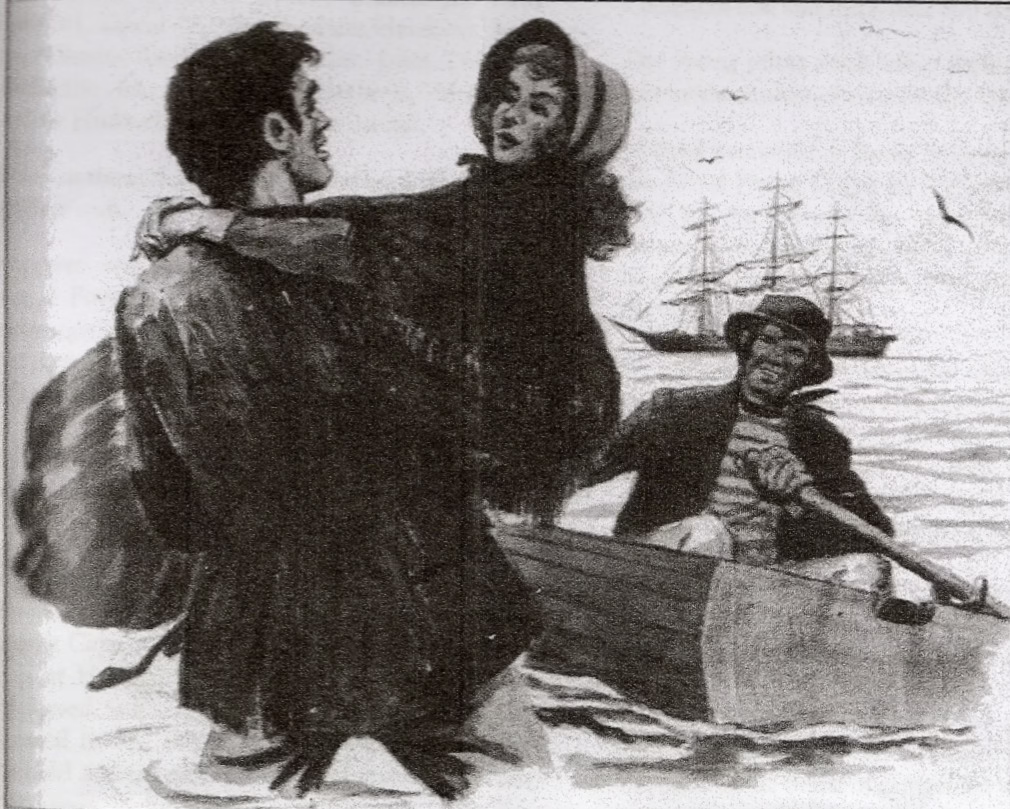
Painting from The Beach Highway by Paul Melody
They, like many others, believed they had bought land through the New Zealand Company. What they believed they were purchasing and what was actually recorded on paper were not quite the same thing—but that would only become clear later. They arrived expecting something prepared. Instead, they had to build almost everything themselves.
I often wonder what they knew, if anything, about the Treaty being discussed and signed hundreds of kilometres to the north. They were civically minded people. Would they have understood its significance? Or were events simply moving too fast for that information to travel, let alone settle?
What I do know is this: two histories were unfolding at once. One was about establishing British authority and commercial settlement. The other was about Māori rangatira attempting to manage a rapidly changing and increasingly dangerous situation.
Good intentions don’t cancel terrible outcomes
Colonisation is often spoken about today as if it were one single thing with one single motivation. In reality, it was messier than that.
There was naked greed and corruption. There was commercial urgency. There was also evangelical humanitarianism—people who genuinely believed they were acting in the interests of human dignity and protection. Some of the same movements that fought to abolish slavery were involved in shaping colonial policy.
And yet, alongside all of this sat a deep sense of cultural and racial superiority. Christianity was frequently tied to “civilisation”. Indigenous ways of life were seen as something to be replaced, improved upon, or moved aside.
Intentions varied. Outcomes did not.
It is entirely possible for people to act with sincerity and still cause enormous harm. History is full of examples of terrible consequences achieved through good intentions. That doesn’t make those consequences any less real.
The story I grew up with
I was born in the 1970s and grew up in the 1980s. It was an era that liked to believe racism was something other people did, somewhere else, in the past.
In New Zealand, we told ourselves a comforting story. We had a treaty. Other countries didn’t. Therefore, we must have done things better. We were told we had the best race relations in the world. When Māori protested, it was often framed as ingratitude, disruption, or unnecessary agitation.
And running underneath all of it was a familiar refrain: It was a long time ago. Get over it.
That logic never really made sense. We commemorate ANZAC Day. We observe Easter. We tell stories of our grandparents and great-grandparents as if the past still matters—because it does. Yet when it came to Māori grievance, the past was suddenly irrelevant.
It wasn’t until I studied law, later in life, that I encountered the fuller story. And it was confronting—not because it made me feel personally attacked, but because it revealed just how partial my education had been.
The scale of dispossession
Much of my thinking here was sharpened by an essay by David Slack, author and fellow McKenzie descendant, Because it’s not too late, which powerfully traces the scale of Māori dispossession and why repair remains both necessary and possible.
The scale of what happened to Māori after 1840 is hard to comprehend.
Through war, confiscation, legal manipulation, and outright theft, Māori landholdings were reduced dramatically within a few generations. Land was not just taken; it was systematically removed through a framework designed to favour settler interests.
This wasn’t incidental. It wasn’t accidental. It was structural.
And land loss was only one part of it. What was damaged and disrupted was an entire way of life—language, authority, economy, governance, and intergenerational continuity. The effects of that loss are not abstract. They show up today in health outcomes, incarceration rates, education gaps, and economic disadvantage.
None of this is mysterious. It tracks directly back to what was done.
Two very different understandings of sovereignty
At the heart of the Treaty debate is a simple but profound issue: sovereignty.
From a Māori worldview, sovereignty was not something you could simply give away. It was inseparable from land, whakapapa, authority, and collective identity. The idea that rangatira would willingly surrender it—especially at a time when Māori vastly outnumbered settlers—makes little sense.
What Māori were seeking was order. Protection. Regulation of increasingly unruly settlers, traders, and commercial interests. The Treaty was a mechanism to manage newcomers, not to erase themselves.
Translation mattered. Language mattered. Worldview mattered. And much was lost—or ignored—in the process.
What struck me deeply when reading Māori scholarship on this was the emotional dimension. In a Māori worldview, mind and heart are not separated. Betrayal is not just legal; it is relational.
Loss that didn’t end in the nineteenth century
The harm caused by colonisation didn’t stop once land changed hands.
Māori were expected to succeed within a foreign system—legal, cultural, linguistic—that had replaced their own. To “get ahead” meant adapting constantly. Code-switching. Adjusting behaviour. Navigating spaces not built with you in mind.
I’ve had small tastes of that feeling myself—living overseas, struggling with language, feeling perpetually out of place. But Māori are asked to do this in their own country.
That realisation shifted something in me. Not toward guilt, but toward responsibility.
Privilege, responsibility, and what we do with it
I don’t feel guilty for what happened in the nineteenth century. I wasn’t there. Guilt isn’t the point.
But I do recognise that I inherit the momentum of a system that works for me. English is my first language. The institutions around me were built with people like me in mind. I don’t have to think about how I sound, how I look, or how I’ll be perceived in most professional spaces.
That is privilege. Not as a moral accusation, but as a description.
The question is what we do with it.
Refusing to acknowledge privilege doesn’t make it disappear. Refusing to use it doesn’t make the system fairer. Responsibility means asking how what we’ve inherited can be used to repair, rather than deny, the past.
What “Tangata Tiriti” means to me
I am not Indigenous to this land. I am also not European in any meaningful lived sense. I was born here. This is home.
The term Tangata Tiriti—a person of the Treaty—helps name that reality. It’s not divisive. It’s descriptive. It acknowledges how we came to be here and what that implies.
Identity work like this isn’t something you tick off and move on from. It’s ongoing. Sometimes uncomfortable. Often humbling.
But it matters.
Learning to sit with discomfort
Decolonisation is not a workshop or a slogan. It’s slow work. It involves unlearning stories that once made us comfortable. It requires resisting the urge to centre ourselves even while reflecting.
As family historians, there’s a particular tension here. We love our ancestors. We defend them. And yet we don’t do them honour by pretending they were untouched by the systems they benefited from.
Truth and love are not opposites. Holding both is the work.
Why this still matters
This is not ancient history. The distance between us and these events is often no more than what a grandparent heard from their own grandparents.
Repair is not about punishment or reversal. It’s about restoring relationship. About honouring promises that were never meant to be temporary.
A richer future is possible—but only if we’re willing to look honestly at how we got here.
If this reflection does anything, I hope it encourages you to explore your own ancestry with curiosity and courage. One ancestor at a time.
Reading list
Weeping Waters – especially the chapter by Margaret Mutu
The Unsettled by Richard Shaw
Becoming Pākeha by John Bluck
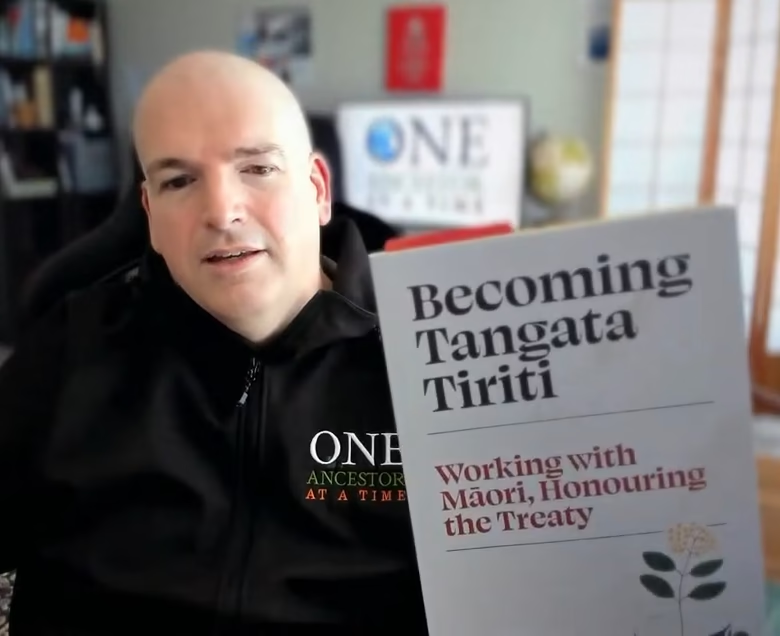
Becoming Tangata Tiriti by Avril Bell
He Tatau Pounamu by Alistair Reese
The Financial Colonisation of Aotearoa by Catherine Comyn
If you like this kind of content, remember to sign up for email updates, and subscribe to One Ancestor at a Time on YouTube.

